📚 MultidomainGold
The dataset is a part of spellcheck_punctuation_benchmark:
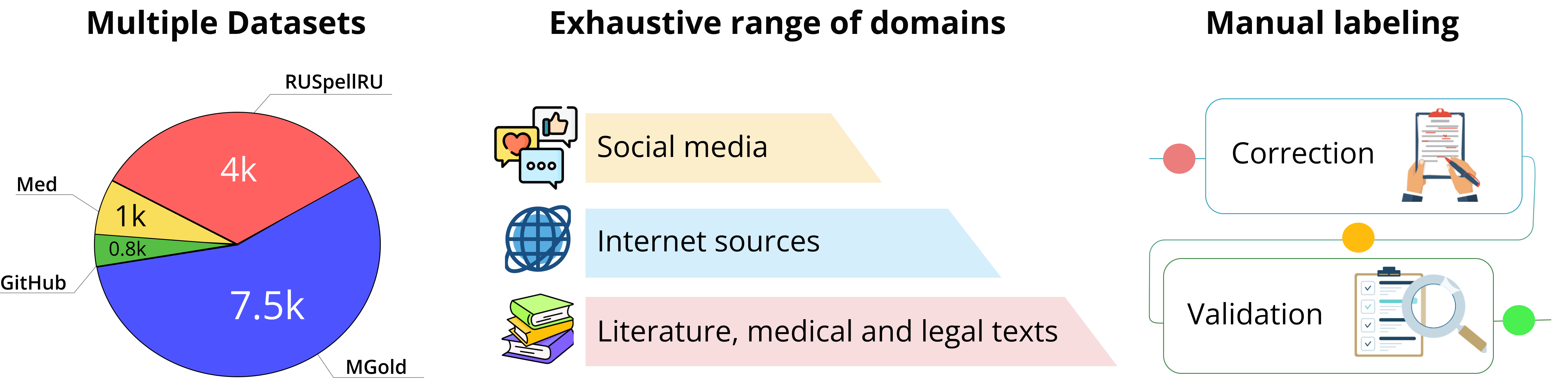
The Benchmark includes four datasets, each of which consists of pairs of sentences in Russian language. Each pair embodies sentence, which may contain spelling and punctuation errors, and its corresponding correction. Datasets were gathered from various sources and domains including social networks, internet blogs, github commits, medical anamnesis, literature, news, reviews and more.
All datasets were passed through two-stage manual labeling pipeline. The correction of a sentence is defined by an agreement of at least two human annotators. Manual labeling scheme accounts for jargonisms, collocations and common language, hence in some cases it encourages annotators not to amend a word in favor of preserving style of a text.
The latter does not apply to punctuation. Punctuation signs are rigorously marked in accordance to the rules of the Russian punctuation system.
Table of contents
Dataset Description
Repository: SAGE
Paper: EACL 2024
Point of Contact: nikita.martynov.98@list.ru
Dataset Summary
The dataset first has been presented in the paper “Augmentation methods for spelling corruptions” by Martynov et al. The corpus is intended to gather texts from a series of sources to provide reasonable diversity of types of errors and their interactions. Almost nine thousand samples from more than 10 domains ensure the lattter.
Supported Tasks and Leaderboards
Task: automatic spelling correction.
Metrics: https://www.dialog-21.ru/media/3427/sorokinaaetal.pdf.
Languages
Russian.
Dataset Structure
Data Instances
Size of downloaded dataset files: 15.03 Mb
Size of the generated dataset: 5.43 Mb
Total amount of disk used: 20.46 Mb
An example of “train” / “test” looks as follows
{
    "source": "для меня всё материальное тленно и лишь находясь в гармонии-для начала с собой-можно радовацца чужому счастью искренне",
    "correction": "Для меня всё материальное тленно, и лишь находясь в гармонии - для начала с собой - можно радоваться чужому счастью искренне.",
}
Data Fields
source: a string feature
correction: a string feature
domain: a string feature
Data Splits
train |
test |
|
|---|---|---|
web |
385 |
756 |
news |
361 |
245 |
social_media |
430 |
200 |
reviews |
583 |
585 |
subtitles |
1810 |
1810 |
strategic_documents |
250 |
|
literature |
260 |
Dataset Creation
Initial Data Collection and Normalization
The source samples were gathered from multiple domains the texts from which are prone to spelling, punctuation errors and rare lexemes.
Aranea web-corpus is a family of multilanguage gigaword web-corpora collected from Internet resources. The texts in the corpora are evenly distributed across periods, writing styles and topics they cover. We randomly picked the sentences from Araneum Russicum, which is harvested from the Russian part of the web.
Literature is a collection of Russian poems and prose of different classical literary works. We randomly picked sentences from the source dataset that were gathered from Ilibrary, LitLib, and Wikisource.
News, as the name suggests, covers news articles on various topics such as sports, politics, environment, economy etc. The passages are randomly picked from the summarization dataset Gazeta.ru.
Social media is the text domain from social media platforms marked with specific hashtags. These texts are typically short, written in an informal style and may contain slang, emojis and obscene lexis.
Strategic Documents is part of the dataset the Ministry of Economic Development of the Russian Federation collected. Texts are written in a bureaucratic manner, rich in embedded entities, and have complex syntactic and discourse structures. The full version of the dataset has been previously used in the RuREBus shared task.
Annotation process
We set up two-stage annotation project via a crowd-sourcing platform Toloka:
Data gathering stage: we provide the texts with possible mistakes to annotators and ask them to write the sentence correctly;
Validation stage: we provide annotators with the pair of sentences (source and its corresponding correction from the previous stage) and ask them to check if the correction is right.
We prepared instructions for annotators for each task. The instructions ask annotators to correct misspellings if it does not alter the original style of the text. Instructions do not provide rigorous criteria on the matter of distinguishing the nature of an error in terms of its origin - whether it came from an urge to endow a sentence with particular stylistic features or from unintentional spelling violation since it is time-consuming and laborious to describe every possible case of employing slang, dialect, colloquialisms, etc. instead of proper language. Instructions also do not distinguish errors that come from the geographical or social background of the source. Instead, we rely on annotators’ knowledge and understanding of a language since, in this work, the important factor is to preserve the original style of the text. To ensure we receive qualified expertise, we set up test iteration on a small subset of the data for both stages. We manually validated the test results and selected annotators, who processed at least six samples (2% of the total test iteration) and did not make a single error. After test iteration, we cut 85% and 86% of labellers for gathering and validation stages. We especially urge annotators to correct mistakes associated with the substitution of the letters “ё” “й” and “щ” for corresponding “е” “и” and “ш” and not to explain abbreviations and correct punctuation errors. Each annotator is also warned about potentially sensitive topics in data (e.g., politics, societal minorities, and religion).
The annotation of punctuation errors has been done in one iteration considering the low variation and difficulty of the task (relative to spelling correction). The annotators have been asked to correct punctuation signs in accordance with the rules of the Russian punctuation system.
Who are the annotators?
Native Russian speakers who passed the language exam.
The annotators for punctuation errors are also professional editors and linguists.
Considerations for Using the Data
Discussion of Biases
We clearly state our work’s aims and implications, making it open source and transparent. The data will be available under a public license. As our research involved anonymized textual data, informed consent from human participants was not required. However, we obtained permission to access publicly available datasets and ensured compliance with any applicable terms of service or usage policies.
Other Known Limitations
The data used in our research may be limited to specific domains, preventing comprehensive coverage of all possible text variations. Despite these limitations, we tried to address the issue of data diversity by incorporating single-domain and multi-domain datasets in the proposed research. This approach allowed us to shed light on the diversity and variances within the data, providing valuable insights despite the inherent constraints.
We primarily focus on the Russian language. Further research is needed to expand the datasets for a wider range of languages.
Additional Information
Future plans
We are planning to expand our benchmark with both new Russian datasets and datasets in other languages including (but not limited to) European and CIS languages. If you would like to contribute, please contact us.
Dataset Curators
Nikita Martynov nikita.martynov.98@list.ru (Spellcheck Punctuation Benchmark)
Licensing Information
All our datasets are published by MIT License.
Citation Information
@inproceedings{martynov2023augmentation,
  title={Augmentation methods for spelling corruptions},
  author={Martynov, Nikita and Baushenko, Mark and Abramov, Alexander and Fenogenova, Alena},
  booktitle={Proceedings of the International Conference “Dialogue},
  volume={2023},
  year={2023}
}

@inproceedings{martynov-etal-2024-methodology,
    title = "A Methodology for Generative Spelling Correction via Natural Spelling Errors Emulation across Multiple Domains and Languages",
    author = "Martynov, Nikita  and
      Baushenko, Mark  and
      Kozlova, Anastasia  and
      Kolomeytseva, Katerina  and
      Abramov, Aleksandr  and
      Fenogenova, Alena",
    editor = "Graham, Yvette  and
      Purver, Matthew",
    booktitle = "Findings of the Association for Computational Linguistics: EACL 2024",
    month = mar,
    year = "2024",
    address = "St. Julian{'}s, Malta",
    publisher = "Association for Computational Linguistics",
    url = "https://aclanthology.org/2024.findings-eacl.10",
    pages = "138--155",
    abstract = "Large language models excel in text generation and generalization, however they face challenges in text editing tasks, especially in correcting spelling errors and mistyping.In this paper, we present a methodology for generative spelling correction (SC), tested on English and Russian languages and potentially can be extended to any language with minor changes. Our research mainly focuses on exploring natural spelling errors and mistyping in texts and studying how those errors can be emulated in correct sentences to enrich generative models{'} pre-train procedure effectively. We investigate the effects of emulations in various text domains and examine two spelling corruption techniques: 1) first one mimics human behavior when making a mistake through leveraging statistics of errors from a particular dataset, and 2) second adds the most common spelling errors, keyboard miss clicks, and some heuristics within the texts.We conducted experiments employing various corruption strategies, models{'} architectures, and sizes in the pre-training and fine-tuning stages and evaluated the models using single-domain and multi-domain test sets. As a practical outcome of our work, we introduce SAGE (Spell checking via Augmentation and Generative distribution Emulation).",
}